

Goetia, explained
20th and 21st century developments

Welcome to an in-depth exploration of a text that has not only captivated the imagination of esoteric practitioners but also intrigued scholars for centuries: The Goetia, often referred to as the first section of the Lemegeton Clavicula Salomonis, or simply the Lesser Key of Solomon. In this study we’re going to delve into the depths of this enigmatic grimoire, exploring its historical origins, ritual practices and the rich variety of entities it describes. In particular, we will engage with its modern-day interpretations and practices, particularly focusing on the 20th and 21st centuries.
The Goetia has a long and convoluted history. It is one of the cornerstones of Western esotericism often mentioned in the same breath as texts like the Book of Enoch, the Emerald Tablet, and the Zohar. Its influence has spanned across various magical traditions and systems, adapting and evolving in meaning and interpretation with each passing generation.The significance of the Goetia is manifold. For some, it is a manual of demonology, providing detailed procedures for conjuring and commanding various spirits. For others, it serves as a symbolic framework for psychological and spiritual exploration, a window into the hidden recesses of the human psyche. As we shall see, the text has been appropriated, revised, and reimagined in numerous ways, particularly in the modern era, revealing its enduring relevance and versatility.
My aim is to offer a nuanced understanding of the Goetia within the broader context of magical traditions, scholarship, and contemporary practice. This will not only enrich our understanding of this specific text but also contribute to the broader scholarly discourse on magic, ritual, and the esoteric. To that end, let’s embark on this intellectual adventure and journey into the intricate world of the Goetia and its modern interpretations, shall we?
As we venture into the past, it’s essential to note that the Goetia, like many other magical texts, does not have a straightforward origin. Early forms of the text can be traced back to the Jewish, Christian, and Greco-Roman magical traditions. A read of Hand Dieter Betz’s seminal work “The Greek Magical Papyri in Translation,” (1992), allows us to see precursors and potential influences in the prayers, conjurations, and various ritualistic elements later found within the Goetia. I also need to premise that there isn’t much academic research on the Lemegeton Clavicula Salomonis, and for this study, I will have to heavily rely on primary sources and adjacent secondary ones.
While it is difficult to pin down the exact date of the Goetia, it is widely accepted that the version we are familiar with today belongs to the late Medieval and early Renaissance period. The text itself is often situated as the first part of the Lemegeton Clavicula Salomonis,
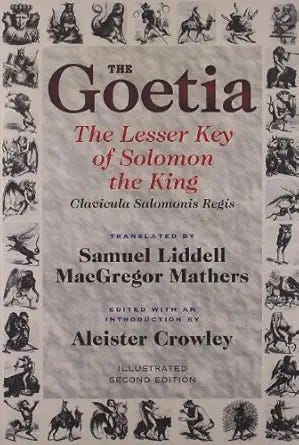
a compilation of several grimoires. This notion of attributing magical works to legendary figures like Solomon was not uncommon during these periods as a way to lend authority and ancient wisdom to the text. The Goetia, along with other magical manuals, significantly influenced the early modern grimoires that flourished during the Medieval and Renaissance eras.
Owen Davies, in his comprehensive “Grimoires: A History of Magic Books,” (2009) explores how these magical books, including the Goetia, shaped the ritualistic practices of the time. They were often used by scholars and occultists who were deeply rooted in the Christian worldview, albeit a heterodox one. One of the most captivating aspects of the Goetia is the meticulous layout of ritual practices.
The text offers a detailed account of the magical circle, a concept discussed in depth by Jake Stratton-Kent in “Geosophia: The Argo of Magic.” (2010). A practitioner is advised to draw a magical circle and a triangle, which serves as the space where the spirit would manifest. The circle is for protecting the magician, and the triangle is to allow the spirit or the demon to manifest. The text also elaborates on the necessary tools and talismans, such as the Hexagram of Solomon and the Pentagram of Solomon, vital for the execution of the ritual.
Equally riveting is the Goetia’s cataloguing of 72 demons, each with its own set of attributes, abilities, and hierarchies. In Lon Milo DuQuette’s “Aleister Crowley’s Illustrated Goetia,” (1992), these demons are presented in a structured way, providing an organised system through which a practitioner can understand their properties and faculties. These entities range from kings like Baal to dukes like Valefar, each serving specific functions and possessing particular powers.
The Goetia presents an intricate hierarchy of 72 demons or spirits, each with distinct qualities, characteristics, and functions. This number, 72, is often symbolically significant in various religious and mystical traditions, suggesting a comprehensive system of influences and powers. Let’s explore this pantheon in more detail.
Classification and Hierarchy
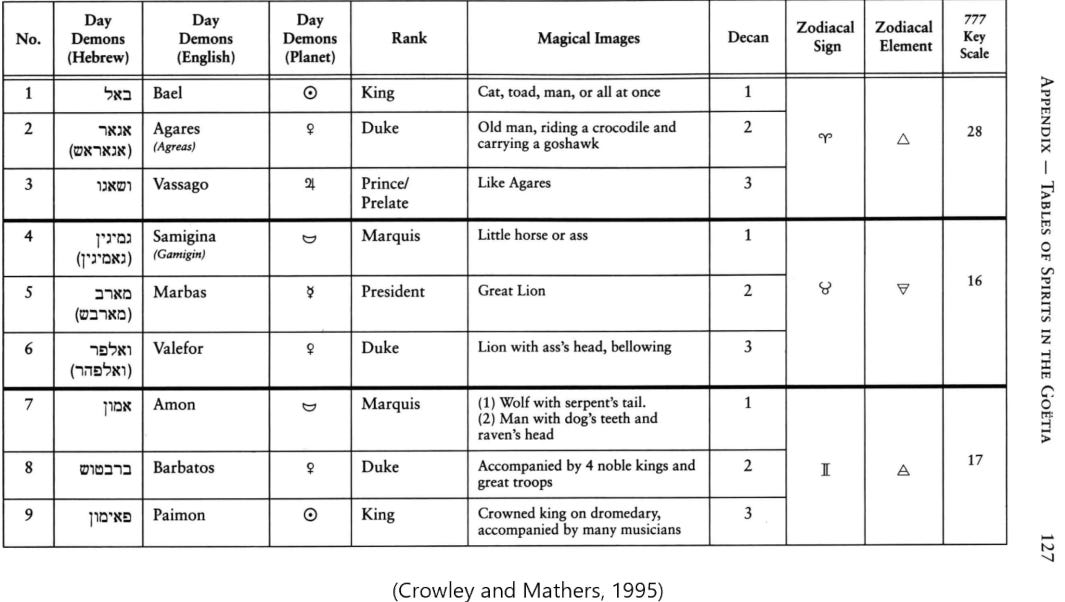
The entities in the Goetia are usually divided into classes, such as kings, dukes, princes, marquises, earls, and presidents, echoing a feudal system. The hierarchy implies a structured universe where the entities have specific domains of influence. Lon Milo Duquette’s illustrated Goetia delves into these illustrations, providing a more structured understanding of the entities and their respective roles. For example, King Paimon is often described as highly obedient to Lucifer and possesses the power to teach any arts and sciences.
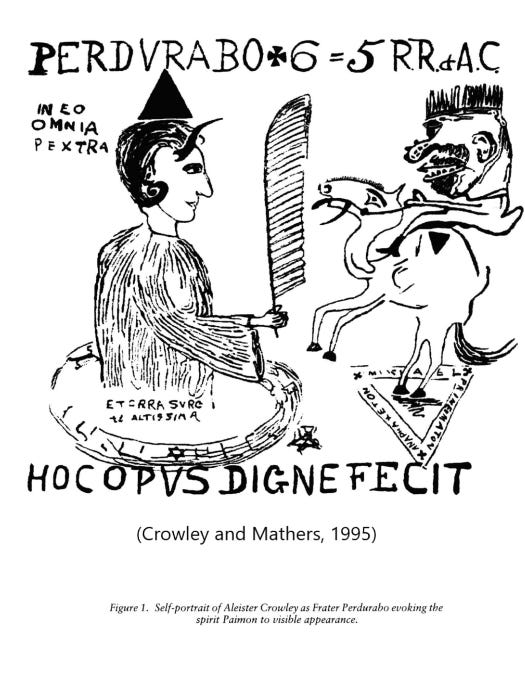
Each demon has a specific set of functions or powers they are believed to control. While some demons can teach arts and sciences, others may bring love or hatred between individuals.
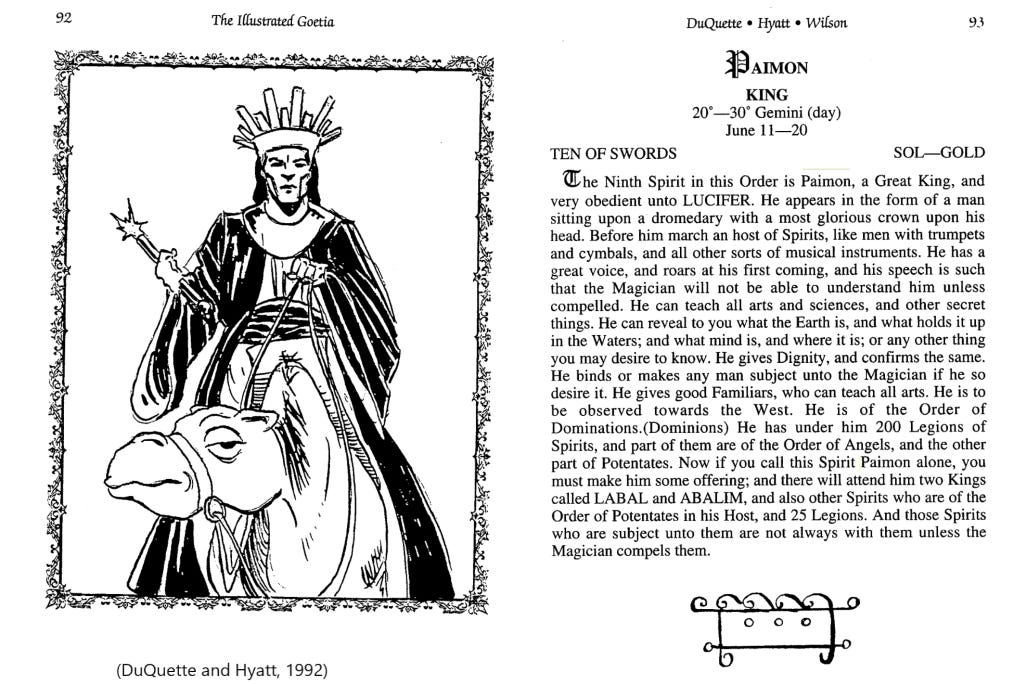
Still, others can manipulate elements or discover hidden treasures. Their abilities reflect a wide range of human desires, needs, and aspirations, encapsulating a comprehensive system of magic aimed at addressing various issues and challenges. The Goetia also provides vivid physical descriptions of these entities, along with their specific symbols and sigils. These are often crucial elements in the ritualistic invocation of the demons. The text seldom makes moral judgements about the entities. Practitioners use these sigils to communicate or command the entities, believing that the sigil acts as a kind of “phone number” to call the particular spirit.
The Goetia’s approach is more pragmatic than ethical; it’s more concerned with how to command these entities effectively rather than questioning the morality of doing so. However, it does lay emphasis on the mastery and control the practitioner must exercise over the entities to avoid detrimental consequences.
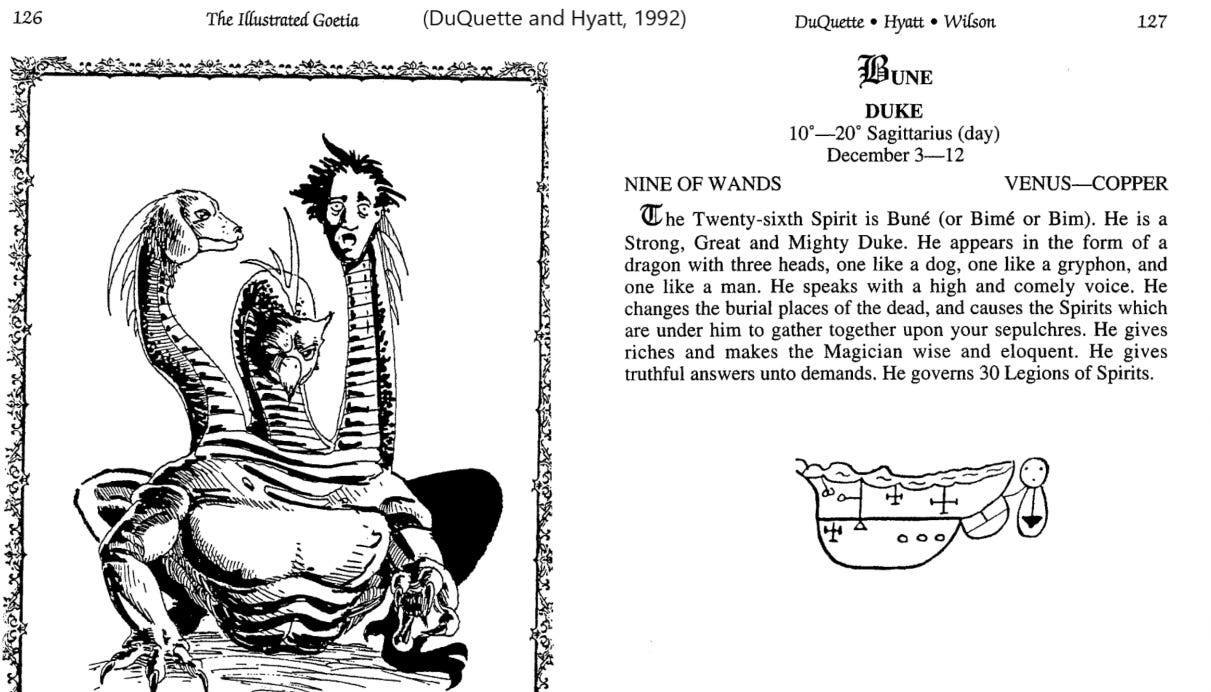
In modern interpretations, especially those influenced by psychological models of the occult, these entities are sometimes seen as manifestations of archetypes of the human psyche. Egil Asprem, in “The Problem of Disenchantment: Scientific Naturalism and Esoteric Discourse,” (2014), discusses how some contemporary practitioners view these demons as psychological constructs that can be manipulated to achieve personal transformation. This is part of the distinction between hard and soft polytheism, a topic we will dedicate an entire other study to, and the psychologizing of entities, a common esoteric stance that sees a strong influence from Aleister Crowley.
Cultural Adaptations
The 72 demons have also found their way into popular culture and modern magical practices that deviate significantly from the original text. Some modern adaptations view these entities as less malevolent, more neutral forces of nature that can be employed for various purposes, reflecting the evolving understanding and approach towards these entities in contemporary magical practices. The Goetia, like any resilient text, has been the subject of multiple reinterpretations, particularly in the 20th century.
Two key movements warrant special attention in this context: Thelema, founded by Aleister Crowley, and Chaos Magick. Aleister Crowley, a key figure in the 20th-century Western esotericism, brought his unique perspective to the Goetia, as shown in the already mentioned manual by Lon Milo DuQuette. This work diverges from the original in several respects, particularly in the approach to the rituals and ethos behind them. Crowley proposed a more streamlined approach, removing some of the elaborate protections and lengthy prayers found in the original text.
This reflected a shift towards personal empowerment and a moving away from the older, more dogmatic ritual structures. The Thelemic interpretation also leans more toward psychological paradigms. Crowley often presented the spirits and rituals as symbolic of internal, psychological states and processes, thereby aligning the Goetia with more contemporary psychological interpretations of magical practice. Chaos Magick emerged in the late 20th century as a highly eclectic and experimental approach to magical practice.
Peter J. Carroll’s foundational text, “Liber Null & Psychonaut,” outlined the principles that would influence Chaos Magick’s approach to the Goetia. In Chaos Magick, there is far less emphasis on the rigid structures and formalities inherent to the original Goetia. Chaos magicians often adapt, modify, or even discard traditional elements, aiming for efficacy over fidelity to the traditional forms. This reflects a postmodern approach to magical practice, wherein traditional forms are seen as flexible tools rather than as immutable truths. In the evolving landscape of modern magical practices, the Goetia’s varied ritualistic procedures offer a broader array of pathways to diverse goals, from acquiring knowledge to securing love or discovering hidden treasures.
This multifaceted system continues to attract scholarly attention, adding layers of complexity to its contemporary interpretation. For instance, Egil Asprem’s work contributes to the academic discourse by examining the Goetia through a psychological lens. In this perspective, the spirits invoked are not necessarily understood as external entities but as metaphors for various aspects of human consciousness. This intellectual engagement enhances our understanding of the Goetia as not merely a catalogue of magical operations but as a text that can be reinterpreted and adapted in line with modern psychological theories, thereby remaining a dynamically evolving and vibrant system.
Contemporary magicians offer an array of unique approaches to working with Goetic entities, enriching the tradition with fresh perspectives. Take, for example, the Ordo Templi Astartes, an esoteric order led by Caroll “Poke” Runyon. This group has not only engaged deeply with Goetic Magick but has also documented its unique methodologies in “The Book of Solomon’s Magick.” This particular case is part of a broader trend in the 21st century that has seen increased inclusivity in the practice of Goetia and other forms of magic.
Scholars like Hugh Urban, in his seminal work, “Magia Sexualis: Sex, Magic, and Liberation in Modern Western Esotericism,” have explored how the inclusion of diverse perspectives, including those from female and LGBTQ+ practitioners, has invigorated and enriched modern magical practices and interpretations of canonical texts like the Goetia. In Chaos Magick, there is far less emphasis on the rigid structures and formalities inherent to the original Goetia. The richness of the tradition is also manifest in the Goetia’s vast repertoire of ritualistic procedures designed for a variety of outcomes. These rituals engage with the 72 demons in the Goetic catalogue each offering a specific path towards goals like acquiring knowledge, securing love, or unearthing hidden treasures. This broad array of magical options ensures the Goetia remains a vibrant and adaptable system, continually updated by the practitioners who engage with it.
Ritual Practice
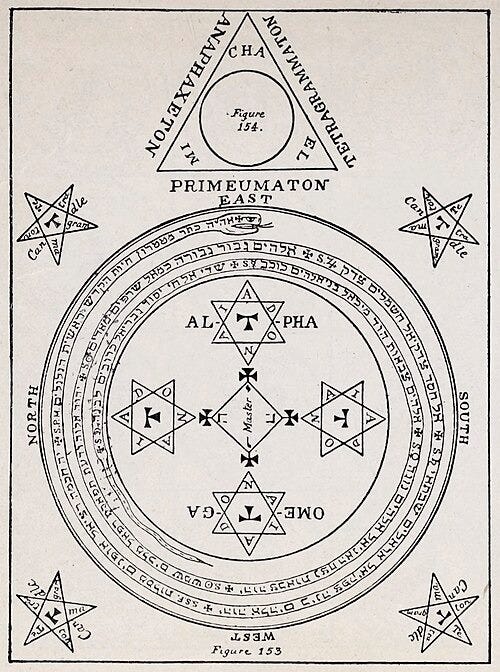
Crowley and Mathers, (1995) The Magical Circle and Magical Triangle
Let’s look into some of the specific ritual examples and types of magic that can be performed using the Goetia as a guide. Please note that this an academic overview and not an endorsement or recommendation to perform these rituals. In the intricate world of Goetic rituals the foundation often starts with the crafting of a magical circle and triangle of manifestation where the magician is protected within the circle of protection, and the demon appears outside of the circle in the triangle of manifestation. The circle is usually inscribed with the divine names and sigils, setting the stage for the ritual, while the triangle is positioned outside this circle, offering a designated space for the spirit’s manifestation.
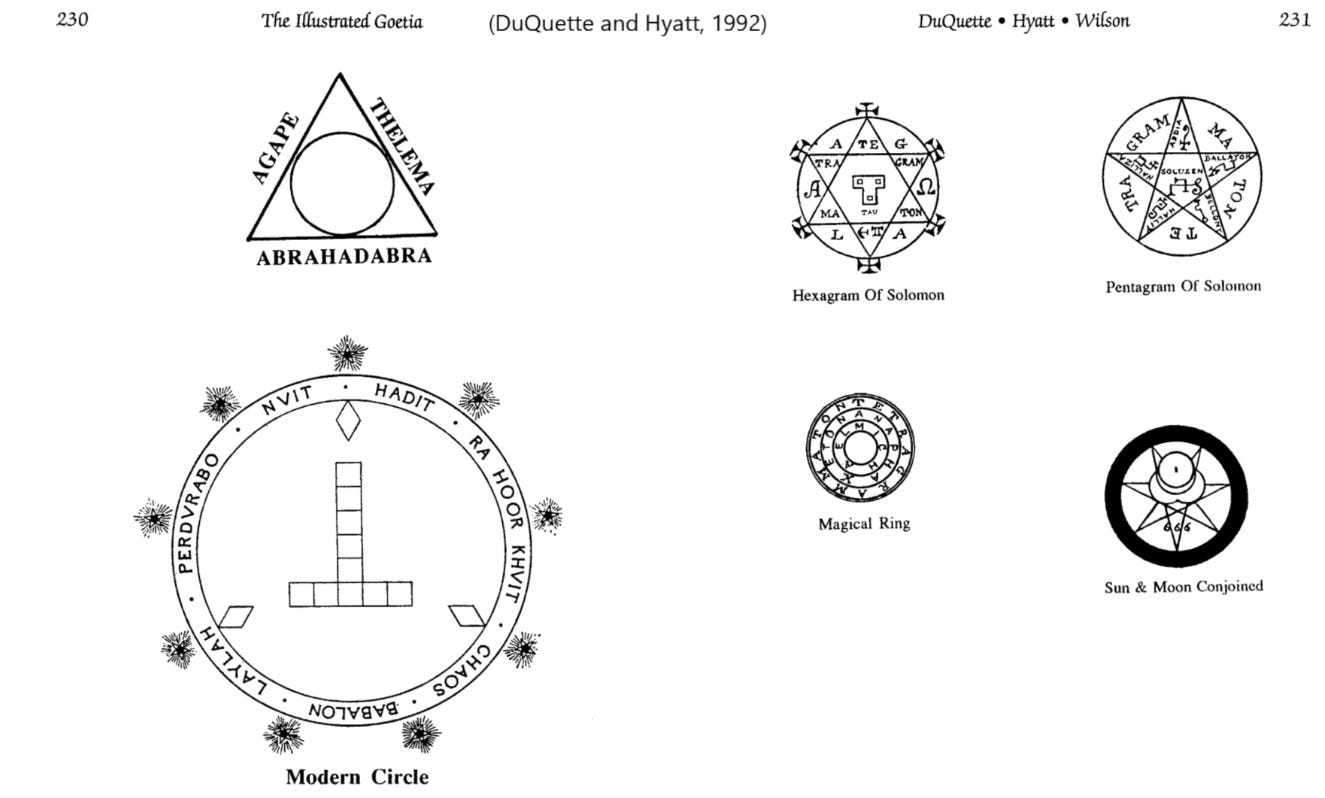
In Goetic rituals, the significance of geometry is complemented by an assemblage of magical tools, each imbued with unique symbolism and function. The Hexagram and Pentagram of Solomon are often employed as powerful protective talismans. In mystical traditions, the hexagram, or six-pointed star, is thought to represent divine union–often between the celestial and the earthly, or the masculine and the feminine.
The pentagram, or five-pointed star, is traditionally used for protection and is a symbol often associated with the four elements; (Earth, Air, Fire, Water) and Spirit, implying a holistic approach to harnessing energies. Alongside these symbols, a sword or a wand is usually included. The sword is often symbolic of authority and the ability to separate, cut or banish; it represents the will of the practitioner exerted upon the spirits. The wand, alternatively, is seen as a conduit for magical energies, offering a more gentle form of guidance and direction. Both tools are employed to exercise control or command over the spirits being invoked.
A chalice is also a standard part of the ritual ensemble. In magical contexts, it often symbolises the element of Water and serves as a vessel for emotional and intuitive energies. In some traditions, it is also a feminine symbol, counterbalancing the masculine energies of the sword or the wand. Lastly, a censor may be included for burning incense. Incense in magical rites often serves multiple roles, such as creating a ritual atmosphere, but it also believed to act as an offering to the spirits or as a way to facilitate altered states of consciousness for the practitioner.
Each tool is not just a physical object but a symbol loaded with philosophical and esoteric significance. They are chosen not just for their form but for their ability to serve specific purposes in the ritual–whether that is for protection, invocation, or exercising authority over summoned entities. Once the space is prepared, the actual ritual can begin. The Goetia is a treasure trove of different ritualistic options; each tuned to the particular demon being invoked and the specific outcome desired.
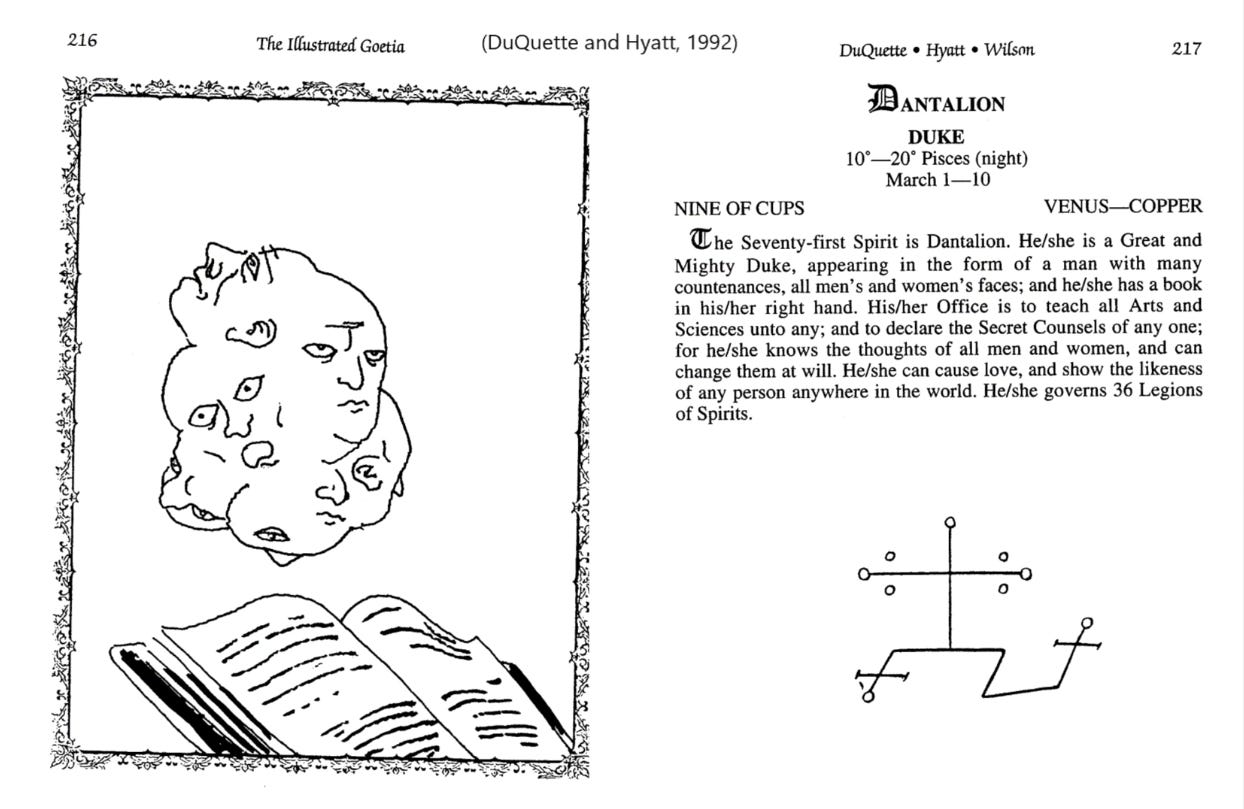
For instance, King Paimon, revered for his wisdom, is often summoned to obtain knowledge and favors. The ritual specifically involves using King Paimon’s sigil and incantations as outlined in the Goetia. Similarly, Duke Dantalion can be invoked to wield influence over another person’s emotions or thoughts, often incorporating specific herbs or oils that resonate with emotional manipulation.
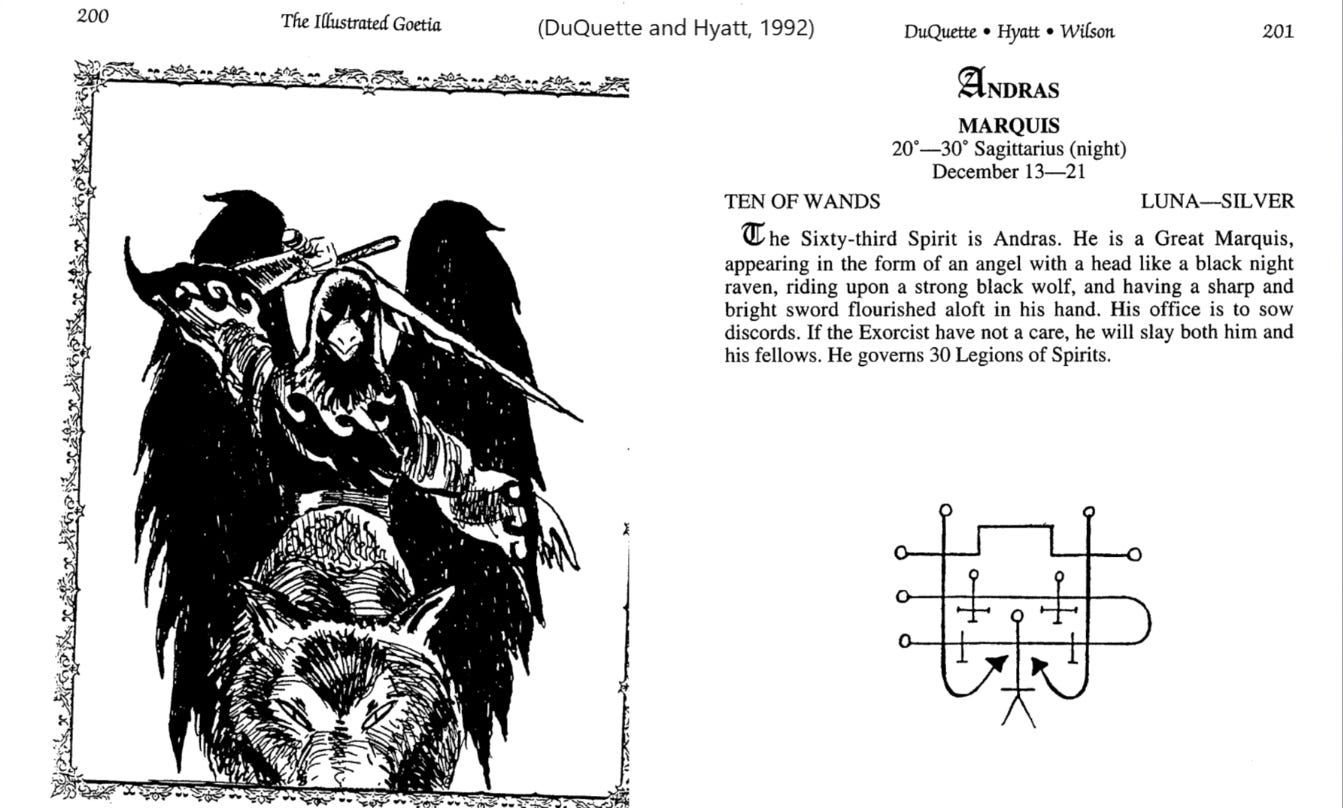
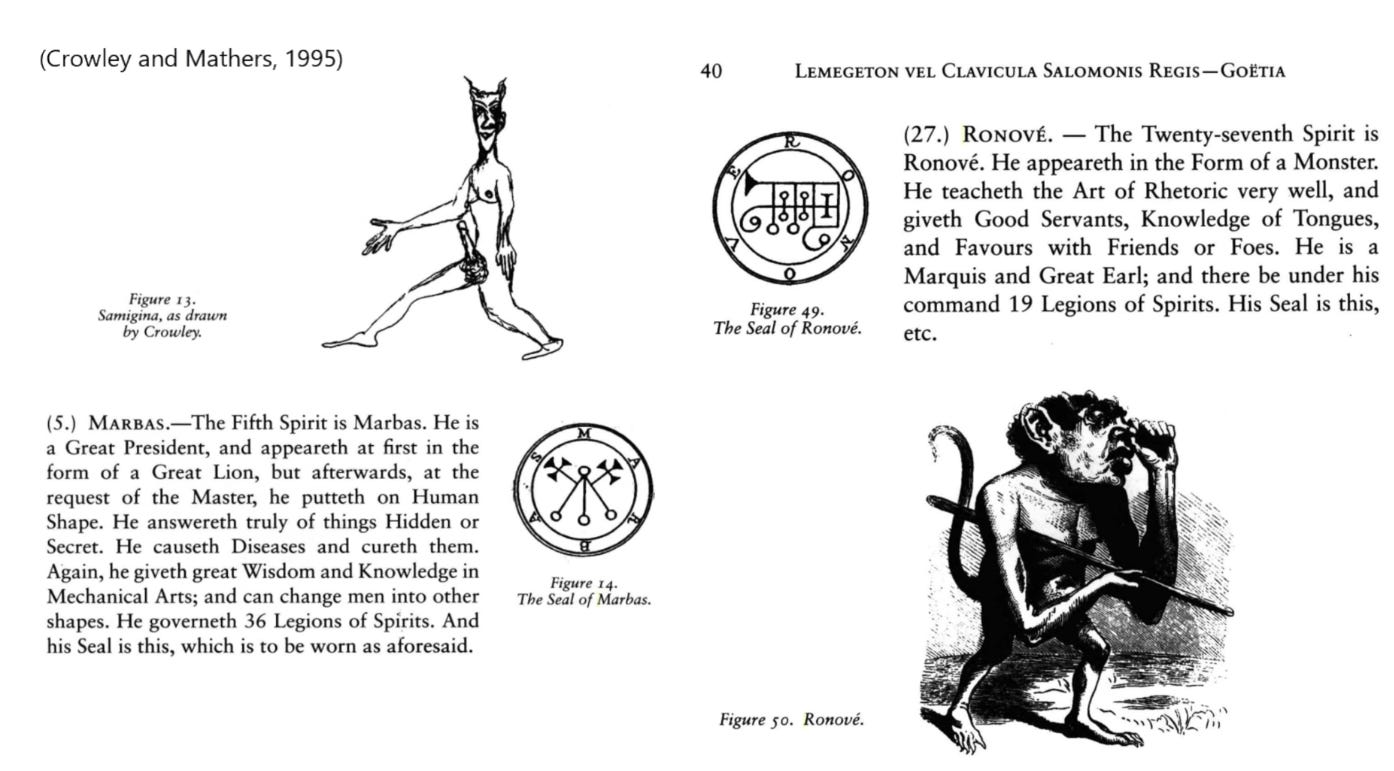
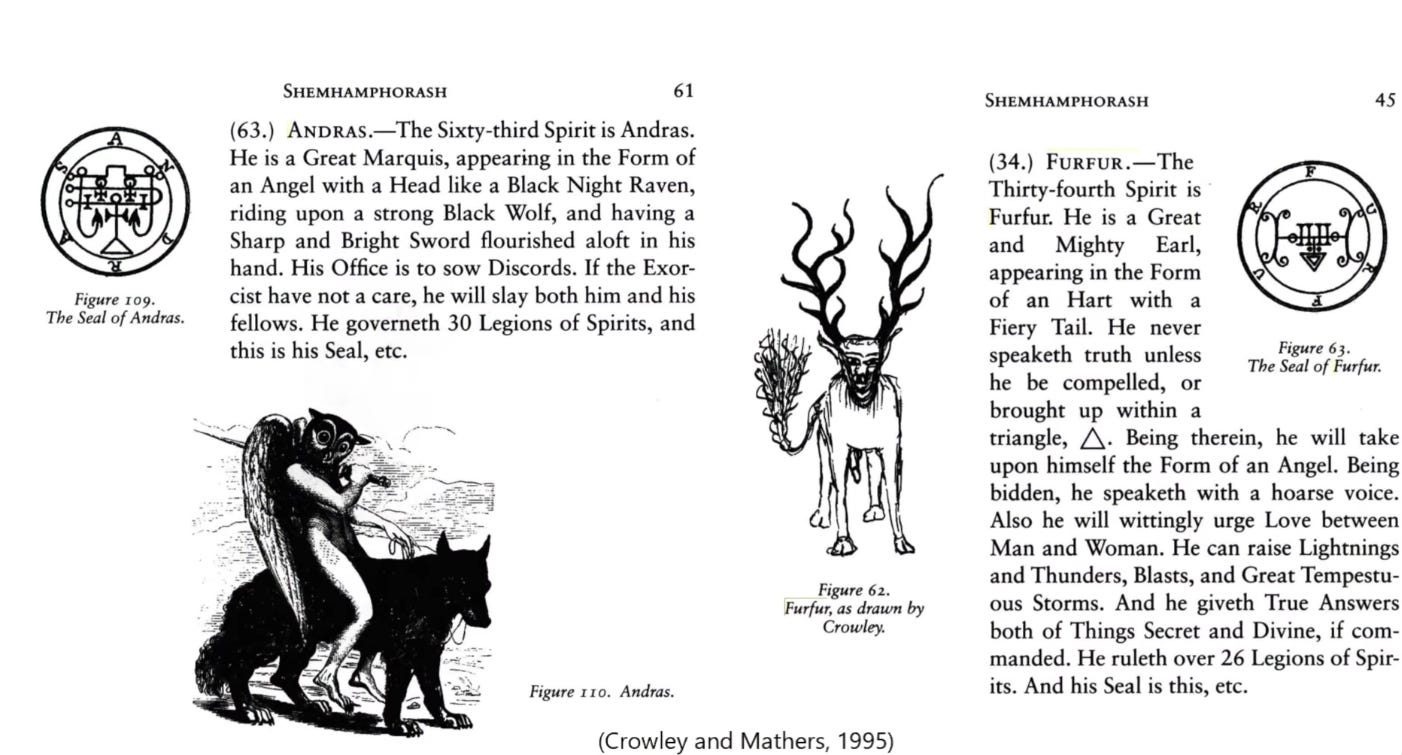
Marquis Andras, a much more volatile entity, is also an option for those looking to sow discord, although caution is advised due to the entity’s unpredictability. The type of magic performed can vary significantly. Some entities like Marbas and Ronove are especially conducive for intellectual and scholarly quests, offering the practitioner wisdom and knowledge.
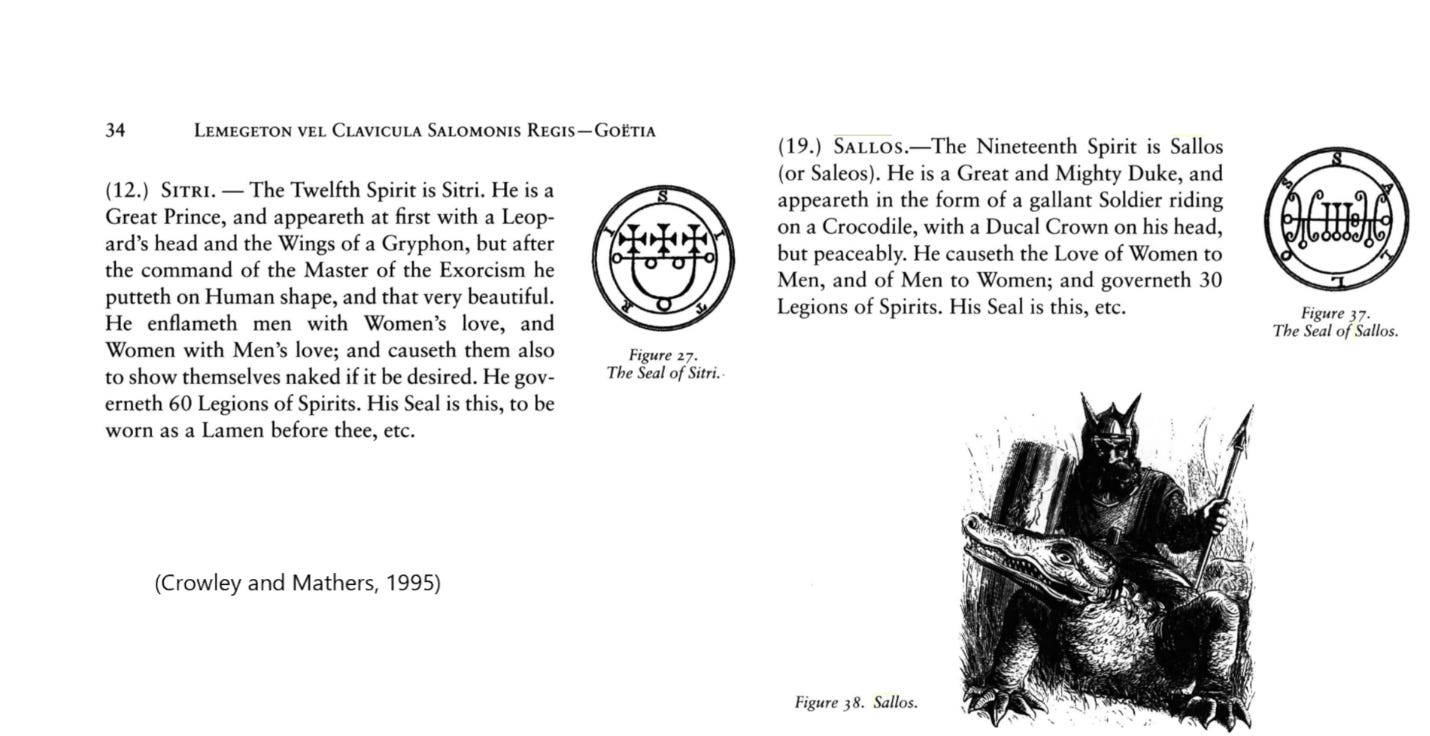
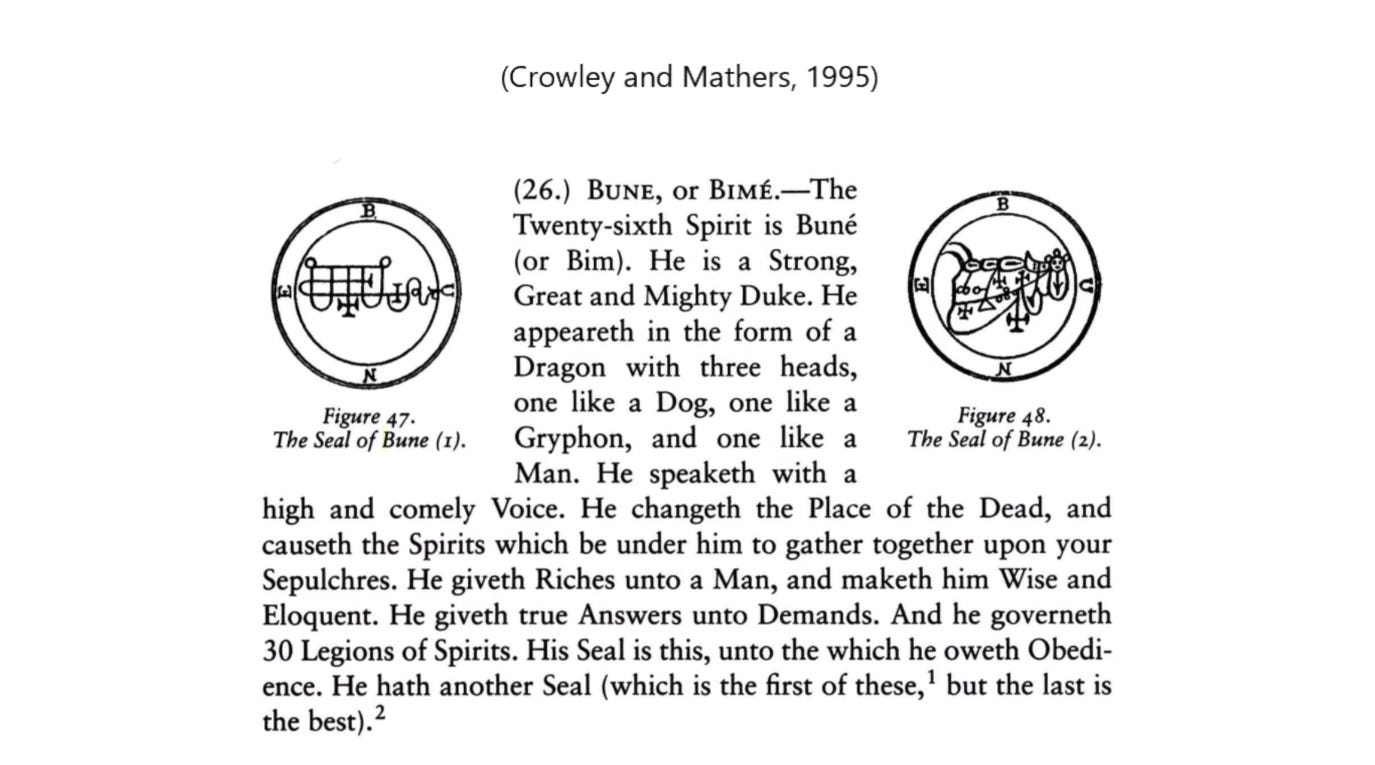
Spirits like Sitri and Sallos specialise in emotional and relational magic, often employed in love spells or relationship building. On the other hand, entities like Bune and Mammon can be invoked for material wealth or business success. Yet, it’s crucial to note that some spirits like Andras and Furfur, are more aligned with baneful magic and are generally considered riskier to engage with.
In contemporary practices, the Goetia’s traditional ritual structures are increasingly being adapted and personalized. Practitioners might replace traditional tools with modern implements that are more readily available or have personal significance. Some even approach these rituals from a psychological standpoint, seeing them as a means to confront or integrate aspects of their own psyche, a view aligned with the work of Carl Jung and later occult analysts.
Ethical considerations are also becoming increasingly prominent. While the Goetia itself doesn’t provide explicit guidelines on ethics, modern magicians often apply their own ethical frameworks, scrutinising issues like manipulation, consent, and the risk of causing harm. In summary, the Goetia offers a robust system that integrates geometry, magical tools, specific ritual procedures, and a plethora of magical aims, all while being adaptable to modern sensibilities and ethical considerations.
The Goetia remains a living text, continuously adapted and reinterpreted to fit contemporary understandings and needs. Its enduring relevance testifies not only to its inherent complexities but also to the flexible nature of magical practices and magical thought. It serves as a vivid example of how ancient wisdom can continue to inform, challenge, and enrich our modern quest for knowledge and mastery, both of the world around us and of the hidden realms within us.